Showing posts with label Rupert Fothergill. Show all posts

Tuesday, June 16, 2009

Photo of the Month - A Little Light Relief


May, 1959: Rupert Fothergill has a little light relief from the serious and strenuous work of game rescue. Here he is seen picking up a leguaan (a species of reptile that looks similar to a small crocodile) out of the water from a small boat. These reptiles are not in any danger, as this is a member of the family of leguaan which live in the water.

Wednesday, April 29, 2009

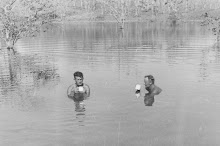
Photo Of The Month - Waiting in the Water

May 1959: Rupert Fothergill, Senior Game Ranger, and an assistant, are seen standing on the submerged branches of a tree which has been very nearly covered by the rising waters of Lake Kariba, while they wait for the rescue boat to pick them up. Fothergill is holding a Hyrax, locally known as a "Dassie" or "Rock Rabbit", which he has just rescued.

Wednesday, March 25, 2009

An AWOL Update

Hello to all! This is just a brief post to let you know that I haven't fallen off the face of the planet, and will be back soon to continue working on this blog and telling the story of Operation Noah.

I was off travelling through South America from May through to December last year and my life has been somewhat hectic since my return. Things will settle down in a few weeks, and then I'll have more time to dedicate to this blog.

In the mean time, I'll treat you animal lovers to some videos of an orphaned oso melero (tamandua) that I was fortunate enough to nurse while doing some conservation work of my own at El Puma Ecological Park in Posadas, Argentina. She was brought in to the clinic at 3 days old - umbilical cord still attached! - after her mother was shot by farmers. My Spanish was so rubbish at this point that I didn't really understand what I was agreeing to when I nodded and said "Sí, sí" and suddenly I found myself landed with 24-hour care of her. Oso melero literally translates to "honey bear", so naturally I named her Winnie.


Sadly, after almost three weeks of three-hourly syringe feeds (even throughout the night) of a mixture of crushed dog biscuits, banana, honey, powdered milk, baby formula and warm water, and despite having gained weight and showing a number of signs of improvement, Winnie died. Apparently this species is notoriously difficult to keep alive in captivity - even as fully grown adults. The nutrition requirements of their natural diet of honey and termites is extremely difficult to replicate. I was told right from the outset that she had only had extremely slim chances of survival, having likely missed out on too much of her mother's colostrum milk, but was nonetheless devastated when she didn't make it.

Pre-feed, searching for "las mamas" (breasts):


With her snout in the trough:


...and now exhausted from all that hoovering, she curls up into a ball for a nap:


And taking her first wobbly steps:

Tuesday, April 29, 2008

In The Mean Time...

I'm actually heading overseas in three weeks time to do some wildlife conservation work of my own in Argentina, so I probably won't be able to keep this blog very well updated until I return.

I'll try to post as much as I can before I leave, and perhaps I'll get a chance to do some work on it while I'm travelling around South America, but in the mean time I'd like to direct you to an excellent article written by Tim Abbott, a conservationist working in the US:

"The Waters Prevailed Exceedingly Upon the Earth" - Rupert Fothergill and Operation Noah

It's a great piece of writing on the work of Grandpa Rupert and his men, with some useful links to other sites.

Saturday, April 26, 2008

Grandpa Rupert - My Hero

I never met my maternal grandfather, Rupert Fothergill. He died ten years before I was born. But I grew up watching him chase rhinos, nurse baby kudu, hold eight-foot pythons and coax porcupines out of their burrows.

Grandpa Rupert was the head game ranger in Rhodesia (now Zimbabwe), one of only a handful employed by the government's National Parks and Wildlife Department. In the late 1950s, when the final gaps were closing in the walls of Kariba Dam, he was assigned to lead a team of fifty men on a wildlife rescue operation of the native animals who called the Zambezi Valley home.

Operation Noah lasted five years, and saw over 6000 animals - from anteaters to zebras and everything in between - relocated from the shrinking islands of Lake Kariba to the mainland. The men lived out of bush camps and had only the most rudimentary of equipment - dinghies, ropes, nets, boxes and sacks - to carry out their mammoth task.

Grandpa Rupert owned a 16mm film camera and documented their efforts. For almost half a century, his footage of charging rhinos, drowning monkeys, netted antelope and caged lions sat in boxes in our family home. Mum and Dad used to dig out the four half-hour episodes edited by the Rhodesian Government in the 60s, and project them against a white board at our childhood birthday parties, or invite the neighbours over for screenings in the garage on rainy Sunday afternoons. But the bulk of the raw footage has not been seen for almost fifty years.

As I write this, I'm digitising Reel 9: it shows Grandpa Rupert feeding two orphaned baby elephants powdered milk from a bucket. By the end of the day, all fifteen reels will have been safely transferred to digital video tape, and backed up on a hard drive. The original acetate film will eventually decay, but the amazing images it holds will be preserved forever.

His photo albums are being scanned as well, and hopefully, some day, I'll be able to put all these assets together and tell the full story of Operation Noah and its heroes.

For now, I'll use this blog as a place to give you a taste of a life less ordinary...